
Dispersion Blades
Dispersion Blades are essential for rapid, high shear mixing, designed to disperse, emulsify, and homogenize products with high speed and precision. Constructed of durable materials such as 304 and 316 stainless steel, and available with Tungsten Carbide coating, they are perfect for the paint, coating, chemical, and food industries where high shear mixing is required. With diameters ranging from 1" to 36", INDCO's Dispersion Blades are built to fit a variety of container sizes and viscosities, ensuring optimal performance in lab and production environments alike. Learn More.
High-shear mixing demands equipment engineered for rapid breakdown, deagglomeration, and thorough dispersion of solid particles into liquids. Dispersion blades (sometimes referred to as Cowles blades) play a critical role in high-shear operations by generating intense mechanical shear and localized flow patterns that efficiently disperse fine powders, pigments, and solids.
INDCO offers a wide selection of dispersion blade designs, sizes, and corrosion-resistant materials engineered for applications ranging from benchtop laboratory testing to full-scale industrial production. Selecting the proper blade design, size, and material compatibility ensures optimal processing speed, particle size reduction, and batch consistency.
Selecting the optimal dispersion blade for a specific mixing application requires evaluating key mechanical and operational variables:
-
Blade Design & Pumping Capacity: All INDCO dispersion blade designs provide high mechanical shear as their primary function, but they vary in their pumping capacity (the ability to move bulk material around the tank) based on tooth size and slope:
- Designs A & E: Feature smaller tooth profiles, providing maximum intense shear with lower pumping capacity.
- Designs B & C: Offer balanced performance with increased pumping capacity to keep heavier slurries in motion.
- Design D: Delivers maximum pumping capacity, utilizing two distinct aggressively sloped tooth styles to drive heavy or viscous materials back into the shear zone.
- Diameter: Blade diameter directly affects operational coverage, power draw, and fluid circulation within the mixing vessel. It must be sized proportionally to the tank diameter, batch depth, and available drive speed.
- Material and Coating: INDCO dispersion blades are manufactured primarily from 304 stainless steel and 316 stainless steel to ensure chemical resistance, durability, and sanitary operation. For highly abrasive slurries, tungsten carbide-coated blades are available to resist premature tooth wear.
- Mounting and Compatibility: Verify center hole dimensions, mounting bolt patterns, hub options, and shaft diameters to ensure seamless attachment to your disperser or mixer shaft.
- Operating Conditions: Blade diameter, operating RPM, and motor horsepower work in unison. High-shear dispersion requires sufficient horsepower to maintain target RPM under load as fluid viscosity builds.
Achieving effective particle size reduction depends heavily on sizing the dispersion blade relative to vessel geometry, placement within the batch, and controlling the blade's tip speed.
Vessel Geometry and Placement Rules
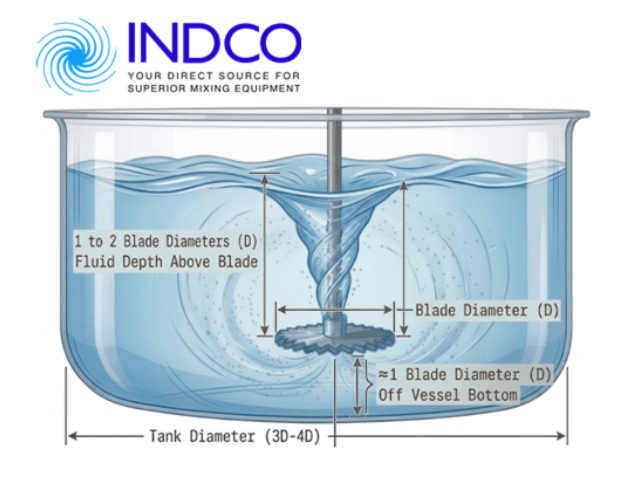
- Blade Sizing: The blade diameter (D) should measure approximately 1/3 to 1/4 of the vessel's inside diameter.
- Off-Bottom Clearance: Position the blade approximately 1 blade diameter off the vessel bottom.
- Liquid Depth: Total batch depth should not exceed three times the blade diameter (3D), and fluid depth above the blade should never be less than the depth below the blade.
- Vessel Shape: Round vessels are strongly recommended over square vessels to eliminate "dead areas" in corners and ensure total circulation.
Tip Speed Calculation
The shear forces required for dispersion are directly governed by blade tip speed—the linear velocity at the outer edge of the rotating blade. Tip speed is calculated using blade diameter (D in inches) and shaft speed (N in RPM):
Tip Speed (FPM) = N (RPM) × 0.262 × D (inches)
For effective high-shear dispersion, an operational tip speed of 4,000 to 6,000 feet per minute (FPM) is targeted to achieve rapid particle breakdown. Operating below 4,000 FPM may result in simple blending rather than dispersion, while excessive tip speeds can induce unwanted air entrainment.
INDCO Engineers are available to help specify just the right equipment for your application.
Dispersion blades require proper mechanical alignment with the underlying disperser equipment. Before ordering replacement blades, confirm the following equipment specifications:
- Shaft diameter and hub style
- Center hole mounting geometry
- Available motor horsepower and speed range (RPM)
- Direction of shaft rotation
Pairing your blade with equipment designed for high-speed operation — such as INDCO's complete line of high-shear dispersers - ensures motor horsepower and drive components can sustain target tip speeds under heavy loads.
Common applications using INDCO high-shear dispersion blades include:
- Paints and Coatings: Dispersing pigments, fillers, and binders into liquid resins.
- Pigments and Inks: Deagglomerating fine color concentrates and printing inks.
- Chemical Processing: Blending suspensions, emulsions, and reactive solid additions.
- Food Processing: Dispersing gums, thickeners, starches, and additives into liquid bases.
- Cosmetics and Personal Care: Creating smooth lotions, creams, and pigment dispersions.
- Laboratory & Pilot Scale: Scalable formulation testing from small benchtop beakers to production trials.
Explore our full inventory of mixing impellers and industrial mixers to pair with your dispersion setup.
What is a dispersion blade used for?
A dispersion blade is a high-speed mixing impeller designed to break down solid agglomerates, reduce particle size, and disperse solids uniformly into liquid vehicles. Unlike standard flow impellers used for blending, dispersion blades rely on high tip speeds and specialized teeth to generate intense mechanical shear. For a detailed breakdown of high-shear mechanics, read The Fundamentals of Dispersion in Mixing.
How do I choose the right size dispersion blade?
Select a blade diameter that measures between 1/3 and 1/4 of your vessel's inside diameter. Ensure your mixer drive motor can maintain the required RPM to hit a target tip speed of 4,000 to 6,000 FPM without overloading. Total material depth should not exceed 3 times the blade diameter.
What is the difference between blade designs (Design A, B, C, D, E)?
All INDCO dispersion blade designs provide high shear. They differ primarily in pumping capacity — how effectively their teeth move bulk material throughout the tank. Design A and E have smaller teeth for lower pumping capacity, while Design D features aggressive angled teeth for high pumping capacity in viscous mixtures.
What is the difference between a dispersion blade and another mixer impeller?
Standard mixing impellers, such as marine propellers, hydrofoils, or axial turbines, are engineered to promote bulk fluid turnover and low-shear mixing. Dispersion blades feature sharp perimeter teeth designed for high-speed operation to tear apart particle agglomerates, prioritizing shear force over high volumetric flow.
How do I know if a dispersion blade will fit my disperser?
Verify the center hole diameter, center hole keyway (if applicable), hub style, center hole bolt circle, and shaft thickness on your existing disperser shaft. INDCO offers multiple center hole configurations and bolt-on hubs to ensure compatibility across laboratory and industrial machinery.
Achieving optimal dispersion performance requires matching your impeller directly to your application requirements. Key variables that dictate proper blade selection include:
- Physical properties and viscosity of the materials being processed
- Vessel dimensions, bottom geometry, and baffling
- Total batch volume and depth
- Existing equipment power, shaft diameter, and RPM limits
- Target particle size and dispersion time goals
If you need technical assistance sizing, selecting, or configuring high-shear mixing components, contact INDCO today or call 1 (800) 851-1049 to speak directly with an application engineer.