
How to Choose Between Dispersers and Mixers for Pigments
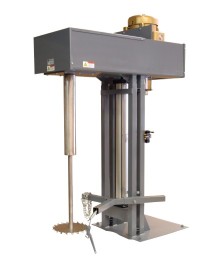
Precise addition of pigments to paints and industrial coatings base formulations can seem like simple mixing applications, but successful final product quality may require more than basic blending.
Paints, coatings, inks, colorants, adhesives, and related materials often depend on consistent pigment distribution to achieve their intended color depth, gloss, stability, and performance. This is why inks and pigments mixing applications require more than basic blending. Utilizing an ineffective production process and selecting the wrong equipment can lead to agglomeration, color shifting, or product separation over time.
Choosing between a flow-based process using an industrial mixing agitator and higher shear pigment dispersion equipment system comes down to understanding how your solids behave in the liquid base and the specific physical changes your formulation requires.
This article will guide you through the technical differences, key decision factors, and equipment options to help you select the ideal INDCO solution for your production needs.
-(1).jpg?sfvrsn=c5e768d4_1)
Understanding the Core Concepts: Blending vs. Dispersion
To make the right equipment choice, it is vital to distinguish the mechanical actions of general mixing from the intensive process of dispersion.
What is Pigment Mixing?
Pigment mixing, or blending, focuses on achieving macroscopic uniformity. It moves liquids and soluble or pre-dispersed solids throughout a tank to ensure the mixture is identical from top to bottom.
A standard pigment mixer utilizes low to medium shear forces to keep particles in suspension, blend different colors together, or incorporate additives. It does not significantly alter the size or structure of the individual solid particles themselves.
What is Pigment Dispersion?
Pigment dispersion is a much more intensive process. Raw pigments naturally stick together in tightly bound clusters called agglomerates. Pigment dispersion requires high shear forces to mechanically break these agglomerates apart into their original, individual primary particles.
During this process, the equipment must also completely "wet out" the pigments, replacing trapped air on the particle surfaces with the liquid vehicle or resin. This particle size reduction and stabilization are what unlock the true color strength, gloss, and UV-resistance of the formulation.
INDCO’s guide on mixing vs. dispersing explains that dispersion is a shear-driven process and that simply adding a dispersion blade to a mixer designed for blending does not create the results of a disperser.
Key Decision Factors: Disperser vs. Mixer
Evaluating five critical process variables will point you toward either a low-shear mixer or a high-shear pigment dispersion equipment setup.
1. Particle Size Reduction & Agglomeration
When to choose a disperser: If you are working with raw, dry powder pigments that arrive in clumped agglomerates, you must use a high-speed disperser. A standard mixer lacks the localized energy needed to split these clusters.
When to choose a mixer: If your pigments are already pre-dispersed into a liquid colorant slurry, or are in miscible liquid form, a properly configured industrial mixer can be effective to blend that colorant uniformly into your base paint or resin.
2. Shear Requirements
High Shear: High shear forces occur when adjacent layers of fluid move at vastly different speeds. This localized stress is what tears pigment clusters apart. High-shear equipment is mandatory for initial dispersion.
Low Shear: Low shear keeps materials moving efficiently without generating excessive friction or heat. It is perfect for heat-sensitive ingredients, final tinting, and general storage agitation.
3. Viscosity and Rheology
Low to Medium Viscosity: High-speed dispersers operate most efficiently within a specific viscosity window (typically 1,000 to 50,000 centipoise). The fluid must be viscous enough to transmit the shear energy from the blade but light enough to maintain a proper vortex through which additives are exposed to the blade.
High Viscosity: Extremely viscous pastes in excess of 50,000 cps may require multi-shaft systems utilizing a slow-moving anchor-shaped impeller to move material from the tank walls while providing high shear from a second rotating shaft.
4. Process Stage: Dispersion vs. Letdown
The Dispersion Stage: The raw pigment, resin, and solvents are mixed under high shear to form a concentrated "millbase." This stage demands a high-speed disperser.
The Letdown Stage: Once the particles are fully dispersed, the millbase is shifted to a low-shear tank mixer. Here, the remaining resins, stabilizers, and tinting colorants are gently incorporated without damaging the polymer structure or creating excess heat.
5. Formulation Components
Consider the sensitivity of your ingredients. If your formulation includes delicate additives or shear-thinning polymers, a high-shear blade can degrade their properties. Use high-shear mixing strictly for the pigment wetting stage, and switch to low-shear mixing equipment for final additions.
Overview of Pigment Dispersion and Mixing Equipment
INDCO designs a complete spectrum of industrial equipment tailored to the unique demands of paint, ink, and coating manufacturers.
-(1).jpg?sfvrsn=7666b5ec_1)
High-Speed Dispersers
High-speed dispersers are the workhorses of the coatings industry. They feature powerful electric motors, heavy-duty shafts, and specialized high-speed impellers operating at tip speeds ranging from 2,500 to 5,000 feet per minute.
They are designed to create a strong vortex that continuously draws dry pigments directly into the high-shear zone of the blade. INDCO’s guide to the fundamentals of dispersion explains that the blade should be approximately one-third of the tank diameter and operate one full blade diameter off the tank bottom.
Tank Mixers and Industrial Mixers for Pigments
INDCO’s tank mixers are engineered for broad, macro-level fluid movement. Available in top-entering or portable clamp-on configurations, these units utilize low-shear impellers like hydrofoils or marine propellers. They excel at letdown stages, final tinting, keeping finished products from settling in storage tanks, and large-scale blending.
Lab Mixers and Pail Mixers
Lab Mixers: Crucial for research, development, and quality control. INDCO’s benchtop lab mixers provide precise speed control, allowing formulators to test dispersion mechanics on a small scale before investing in full-scale production runs.
Pail Mixers: Ideal for small-batch operations, touch-up batches, or on-site tinting. INDCO offers portable pail mixers that fit standard 5-gallon containers, providing clean, efficient blending without the need for massive fixed tank setups.
-(1).jpg?sfvrsn=7b337bad_1)
The Role of the Dispersion Blade
A high-speed disperser is only as effective as its physical point of contact with the fluid: the dispersion blade. The geometry of this dispersion blade dictates how energy is transferred into your pigment millbase.
Design "A" (Standard Disperser Blade): The most common option, featuring alternating teeth that project upward and downward. It generates a balance of high shear and excellent radial flow, making it perfect for standard paints, inks, and clear coats.
High-Vane Blades: Featuring deeper, more pronounced teeth, these blades provide enhanced pumping action. They are used for thicker materials or formulations with higher solids content where fluid movement becomes sluggish.
Bow-Tie Blades: Designed specifically for extremely high-viscosity pastes, heavy adhesives, and thick mastics. They provide a powerful lifting and folding action to prevent the product from riding along with the blade without mixing.
To maintain optimal process control, operators must regularly inspect blades for wear. As the sharp edges of the teeth round off over time due to abrasive pigments, the localized shear drops significantly, resulting in longer cycle times and poor particle breakdown.
Summary Checklist for Equipment Selection
Use this quick checklist to audit your process before selecting your INDCO equipment:
Identify the raw material state: Are you adding dry, agglomerated powders (requires a disperser) or liquid color concentrates (requires a mixer)?
Define target viscosity: Is your formulation under 50,000 cPs (standard disperser) or is it a heavy, unyielding paste (heavy-duty mixer or specialized blade)?
Determine your process stage: Are you grinding a raw millbase (high shear) or completing a letdown/tinting step (low shear)?
Establish batch size: Do you need benchtop scalability (lab mixer), small job flexibility (pail mixer), or large-scale manufacturing capacity (fixed tank mixer)?
Review ingredient sensitivities: Do you have components that will break down under high heat or intense mechanical stress?
Frequently Asked Questions
Can I use a standard mixer to disperse pigments?
No. Standard flow-based mixing equipment lacks the velocity and specialized blade edge geometry required to break down agglomerates. Using a standard mixer for raw pigments can result in a grainy final product, poor color development, clogging in spray equipment, and rapid settling of solids.
What is the ideal viscosity range for a high-speed disperser?
Single-shaft, high-speed dispersers operate best between 1,000 and 50,000 centipoise (cPs). In this range, the fluid is thick enough to create the internal friction necessary for particle breakdown, yet fluid enough to maintain a flow pattern that ensures all material passes through the blade. The intensity of the vortex decreases rapidly as the viscosity of the formulation increases.
How do I know when my pigment is fully dispersed?
Full dispersion is often verified using a Hegman grind gauge. This instrument measures the size of the remaining particles in micrometers. Once your sample registers the specific Hegman rating required by your formulation, your dispersion phase is complete.
How does blade wear affect the dispersion process?
Abrasive pigments like titanium dioxide gradually wear down the sharp edges of a dispersion blade. As the teeth round off, the blade loses its ability to generate high localized shear. This leads to longer batch times, increased energy costs, elevated product temperatures, and inconsistent grind quality. Blades should be replaced regularly.
Can a high-speed disperser handle high-viscosity materials?
To a point. Standard high-speed dispersers struggle when viscosities exceed 50,000 because the material resists flow and adheres to the mixing vessel wall. Extremely viscous materials may require a dual-shaft mixer utilizing an anchor-style impeller to move materials to the blade.
If you need help configuring the right motor horsepower, shaft length, or blade style for your specific formulation, contact INDCO’s application engineers. We can help you choose from our extensive line of high-speed dispersers, industrial tank mixers, lab mixers, and high-quality dispersion blades to keep your production line running smoothly.